
What I Learned From Jesse Jackson
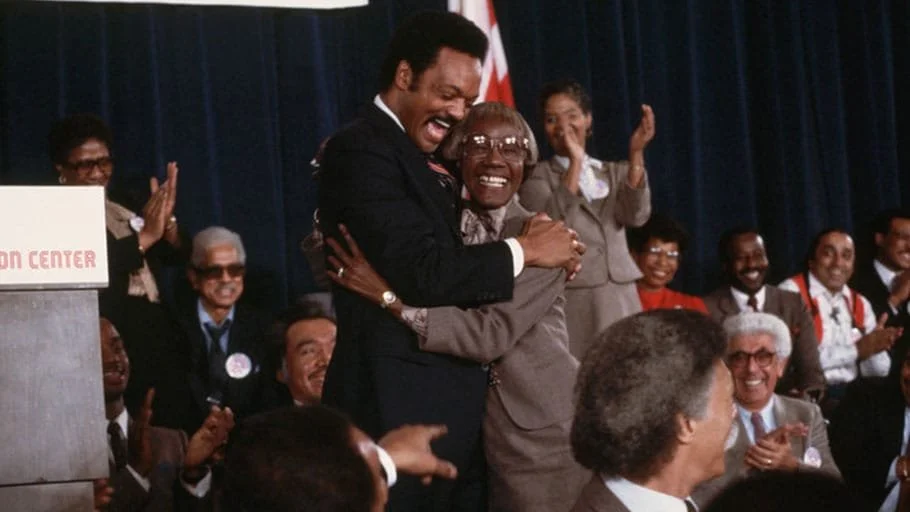
Jesse Jackson and Shirley Chisholm, 1983 — one trailblazer embracing the one who came after her.
Last week, Rev. Jesse Jackson—a stalwart of the American Civil Rights struggle—was laid to rest. His public life, which spanned sixty years, left an indelible imprint on American politics, global movements for justice, and how countless Black and brown children saw themselves and their prospects.
From cries of “I am somebody” to “Keep hope alive,” Jackson expanded the public imagination and opened realms of possibility others previously deemed impossible. While his activism was not without its controversies, missteps, and mistakes, his life leaves us with lessons relevant for any changemaker—whether the change you seek is at the ballot box or in the boardroom.
Perhaps the most critical lesson: winning isn’t the only way to leave a legacy.
A Campaign That Changed the Rules
Following in the footsteps of Shirley Chisholm—the first Black person to run for president on the ballot of a major party—Jackson campaigned for the White House in 1984 and 1988. When he ran in ‘84, very few believed he could win. He finished third in the Democratic primary, garnering over 3 million votes—nearly 20% of all cast in primaries—but received only 8% of delegates due to winner-take-all rules he criticized as fundamentally unfair.
While his efforts fell short of securing the nomination, what he did win was a larger audience for his progressive platform: a multiracial “Rainbow Coalition” of people from every walk of life, including the LGBT+ community, farmers, religious communities, and the economically disenfranchised. Domestically, his platform was inclusive, calling for measures such as reparations for American chattel slavery and ratifying the Equal Rights Amendment. Internationally, his politics were equally progressive—opposing apartheid South Africa and calling for an independent Palestinian state.
In 1988, Jackson ran again—with greater credibility, more funding, and a sharper campaign team. He more than doubled his 1984 results and, for a moment, was the frontrunner. He ultimately came in second for the Democratic nomination behind Michael Dukakis, but notably ahead of future Vice President Al Gore and future President Joe Biden.
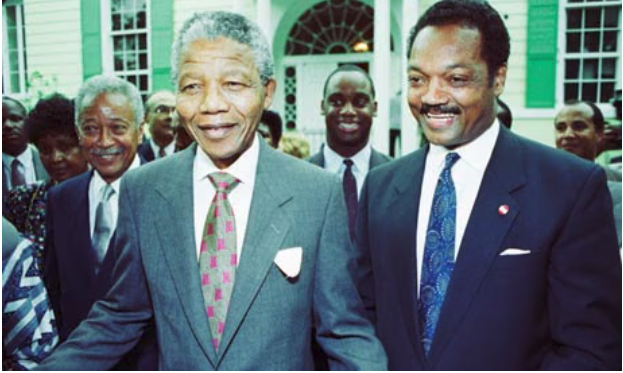
Nelson Mandela and Rev. Jesse Jackson, London, April 1990
The Well He Dug
But Jackson’s most lasting political legacy came after his ‘88 race, when he pushed the Democratic Party to abandon its winner-take-all delegate model in favor of proportional representation. Under the new rules, any candidate who gained 15% of the vote in a state would receive a proportional share of its delegates. It is this rule—still in place today—that ultimately paved the way for Barack Obama to gain enough delegates across the country to become the 44th and first Black president of the United States.
It was also through his campaigns that many of the 20th and 21st centuries’ most influential Black political leaders cut their teeth. Notably, “The Colored Girls”—Donna Brazile, Yolanda Caraway, Leah Daughtry, and Minyon Moore—began their careers in Jackson’s ‘84 campaign, a partnership that endures today.
What This Means for You
I don’t write all of this because Jackson was perfect, or because I agree with every aspect of his legacy. I write this because too many of us measure our success by one undesired outcome instead of considering the totality of our contribution.
Many of you are working in spaces that were not designed for you to thrive or succeed. But by being in the room, raising your voice, and naming your agenda, you can help ensure that business does not continue as usual—and that those who come after you have better opportunities.
When I learned of Jesse Jackson’s passing, the words that came to me were those of the South African writer Zakes Mda, who in delivering the 2001 Steve Biko Memorial Lecture wrote: “In Sesotho there is a saying: ‘Motjheka sediba ha a se nwe’ (‘he who digs a well does not drink from it’). Only those who come after him will quench their thirst from its cool water.”
Jackson never made it to the White House, but the well he dug? Barack Obama drank from it. So did The Colored Girls, and generations of Black political leaders who followed.
A Question Worth Sitting With
If you’re in a season where you’re questioning whether your presence matters, it might be time for reflection and realignment. Sometimes the most powerful move we can make is to clarify where we’re digging—and who we’re digging for.
Reflections like this one land in inboxes every Thursday. If you want more, subscribe to Thursday Thoughts—it’s free, it’s honest, and it’s written for people doing meaningful work in complicated times.